


Getting to the Galapagos Islands: Everything You Need to Know About Flights
Traveling to the Galapagos is simpler than most people expect once you know how the journey works. Since there are no direct international flights to the islands, travelers first fly to mainland Ecuador before continuing to the Galapagos on a domestic flight. With the right planning, choosing your connections and completing the necessary travel requirements is straightforward.
How flights to the Galapagos Islands work
Only Quito and Guayaquil are authorized to operate flights to the Galapagos. This isn't a routing quirk — it's a deliberate control measure. Concentrating all traffic through two airports lets the National Park run the biosecurity screening and entry checks that protect the islands' ecosystem, and it keeps the aircraft serving the archipelago smaller, limiting the environmental footprint of air travel to this fragile destination.
The Galapagos has two airports, both served exclusively by domestic flights from the Ecuadorian mainland:
- Baltra (GPS): Flights operate from Quito (approx. 2 hrs 15 min–3 hrs, depending on a technical stop in Guayaquil) and Guayaquil (approx. 1 hr 45 min).
- San Cristóbal (SCY): Flights operate from Quito (approx. 2 hrs 15 min–3 hrs, depending on a technical stop in Guayaquil) and Guayaquil (approx. 1 hr 45 min–2 hrs).
Two airlines operate these domestic routes: LATAM and Avianca, with multiple daily departures from both cities. Which airport you arrive at in the Galapagos depends on your specific route, itinerary, or trip plan.
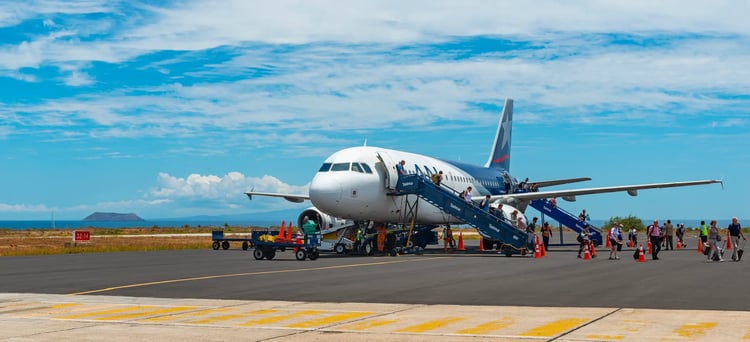
To keep your journey running smoothly, we recommend arranging your domestic Galapagos flights alongside the rest of your travel plans. Most travel agencies coordinate domestic flights within the itinerary, ensuring smoother connections and a more relaxed journey to the Galapagos.
Most international flights from the US and Europe land in Ecuador in the evening, while flights to the Galapagos depart in the morning. That mismatch is why an overnight stay in Quito or Guayaquil is standard practice, not an extra precaution. It gives you a buffer for delays and a realistic night's sleep before an early departure.
In simple terms, your journey looks like this:
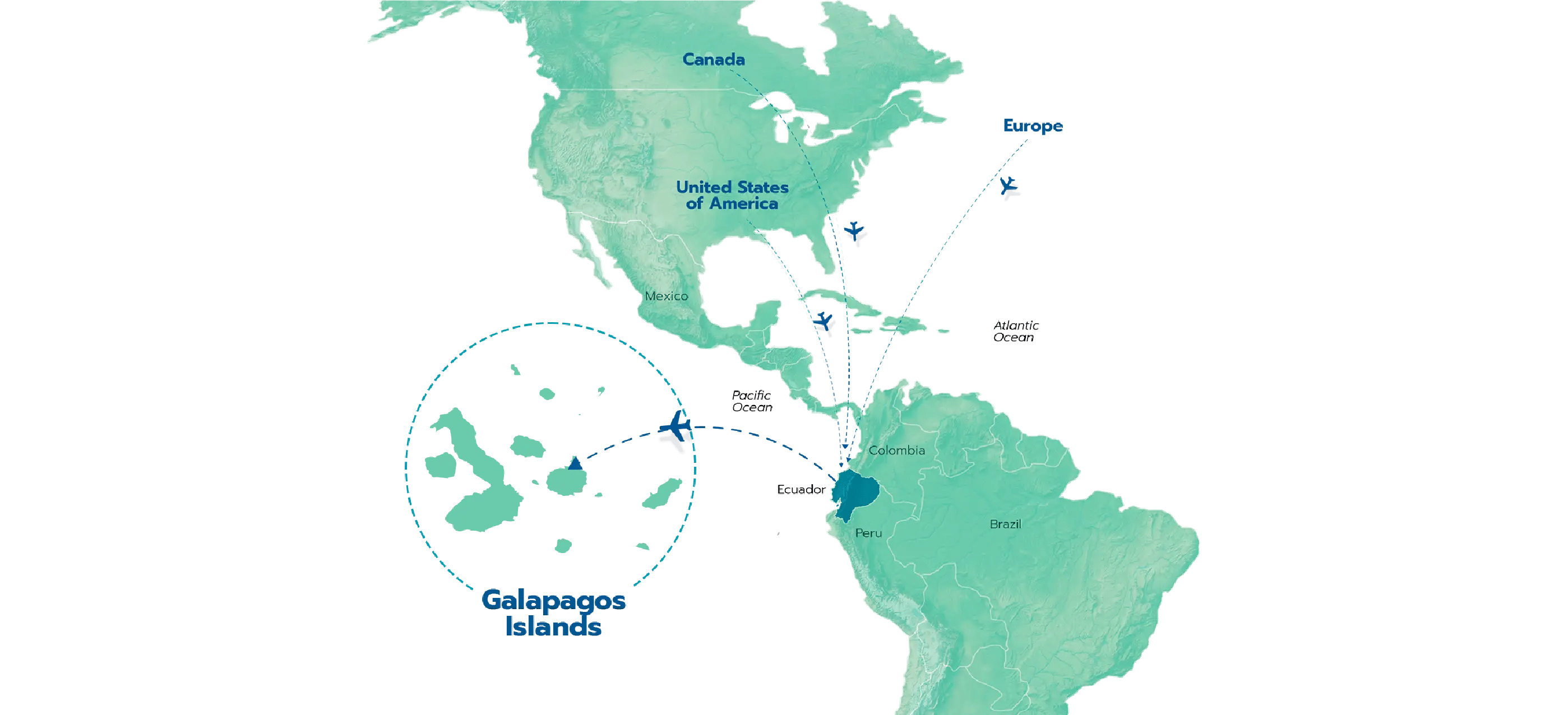
Getting to Ecuador: international connections by region
-
From the United States
For U.S. travelers, the route to the Galapagos often starts in Miami or Houston. Both offer direct access to Ecuador, while other departure cities may require an additional connection before reaching Quito or Guayaquil. From there, the final flight takes you to Baltra or San Cristobal.
-
From Canada
Starting in December 2026, Air Canada will connect Montréal and Toronto directly with Quito, creating a more convenient route for Canadian travelers continuing to the Galapagos Islands. With Quito as the gateway, travelers can easily connect to domestic flights to Baltra or San Cristóbal, or spend a few days discovering Ecuador’s capital before beginning their Galapagos expedition.
-
From Europe
Travelers from the UK and Europe have several ways to reach Ecuador. Depending on the departure city and current airline schedules, routes may include direct service from selected European gateways or connections through major European, U.S., or Latin American hubs. From Quito or Guayaquil, travelers continue to the Galapagos Islands on a domestic flight.
-
From Australia and New Zealand
Traveling from Australia or New Zealand to Ecuador requires at least one connection, with Santiago, Chile, serving as one of the most convenient gateways to South America. Depending on the airline and departure city, travelers can connect onward to Quito or Guayaquil before continuing to the Galapagos Islands. Total travel time typically runs 26–30 hours including connections. Given the long journey, many travelers choose to include a stopover along the way, making the trip more comfortable and turning the journey to Ecuador into part of the overall experience.
Galapagos Islands flight time by origin
Here’s how long the journey to the Galapagos can take from major cities, including connections and layovers.
|
Origin |
Typical Routing |
Sample Total Time |
Notes |
|
Miami (MIA) |
Miami → Quito or Guayaquil |
~7–8 hrs |
One of the most frequent US connections. Multiple daily departures available. |
|
New York (JFK/EWR) |
NYC → Miami or Bogotá → Quito |
~10–12 hrs |
One stop via Miami or Bogotá. Several daily options depending on carrier. |
|
Houston (IAH) |
Houston → Quito |
~8–9 hrs |
Direct service available. Good option for central and southern US travelers. |
|
Los Angeles (LAX) |
LAX → Miami or hub → Quito/Guayaquil |
~12–14 hrs |
Typically two legs. Allow extra connection time when booking. |
|
Chicago (ORD) |
Chicago → Miami → Quito |
~12–13 hrs |
One stop via Miami is the most common routing. |
|
Toronto (YYZ) |
Toronto → Quito (nonstop from Dec 2026) |
~9–10 hrs |
Air Canada nonstop launching December 4, 2026. Saturdays. Seasonal service. |
|
Montreal (YUL) |
Montreal → Quito (nonstop from Dec 2026) |
~8–9 hrs |
Air Canada nonstop from December 2026. Sun/Wed/Fri departures from YUL. Seasonal. |
|
London (LHR) |
London → Miami or Bogotá → Quito |
~18–20 hrs |
Multi-stop routing. Plan for a connection or overnight in a hub city. |
|
Sydney / Auckland |
Sydney/Auckland → Santiago → Quito/Guayaquil |
~26–30 hrs |
No direct flights. LATAM connects via Santiago, Chile. Most travelers build in a stopover given the distance. |
Flight to Galapagos Islands from Canada: Air Canada's new nonstop service
Air Canada is launching nonstop flights between Canada and Quito starting December 4, 2026 — the first direct service between the two countries in years. Toronto (YYZ) departs Saturdays; Montreal (YUL) departs Sunday, Wednesday, and Friday evenings (arriving Monday, Thursday, and Saturday in Quito). The service operates on a Boeing 787-8 Dreamliner through March 2027, aligning with the Galapagos warm season. From Quito, the domestic connection to Baltra or San Cristóbal adds approximately 3 hours — making the islands reachable in a single travel day from Toronto or Montreal for the first time.
This is a seasonal service for the 2026–2027 winter period. Canadian travelers planning a Galapagos expedition during this window should confirm domestic Galapagos flight availability at the same time as international booking — high-season seats fill early.
 Travel entry requirements
What you need to complete before you board
Before you can board your flight to the islands, there's a short list of Galapagos-specific entry requirements, which are worth checking first if you haven't already. Here's what applies once you're headed to the archipelago:
|
TCT — Transit Control Card |
$20 USD |
Digital, before travel. Register and pay online at gobiernogalapagos.gob.ec at least 48 hours before your flight. Present the TCT (digital or printed) at the CGREG counter at Quito or Guayaquil airport before check-in. |
|
ABG Biosafety Sworn Declaration |
Free |
Digital, before travel. Complete online at declaracion.abgalapagos.gob.ec 48–72 hours before your flight. Required for travelers 18+. You'll also pass a physical baggage inspection at the mainland airport before check-in. |
|
Galapagos National Park entrance fee (PNG) |
$200 USD adults / $100 USD children under 12 |
In person, on arrival. Paid in cash at Baltra or San Cristóbal airport, before immigration. Not completed online. |
Total mandatory entry fees: $220 USD per adult, separate from your cruise or tour package. Plan to arrive at the mainland airport at least 2.5 hours before your Galapagos flight: the ABG inspection, CGREG counter, and airline check-in are three separate queues.
Have USD cash ready for the National Park fee — neither Baltra nor San Cristóbal has an ATM, so withdraw what you need in Quito or Guayaquil beforehand. And once you land, set your watch back an hour: the Galapagos runs one hour behind mainland Ecuador, which matters for cruise check-in and excursion timing.
🔗 What to pack for te Galapagos?
Baltra or San Cristóbal: which airport do you fly into?
The answer depends on your itinerary in the islands, whether that's an expedition cruise or an island-hopping trip. Here's the general logic:
-
Baltra (GPS): Standard entry point for itineraries centered on Santa Cruz, including most expedition cruise departures. A bus and ferry transfer connects the airport to Puerto Ayora, roughly 45 minutes.
-
San Cristóbal (SCY): Entry point for eastern itineraries and trips based in Puerto Baquerizo Moreno. A short taxi ride connects the airport to the main dock.
Can you fly into Baltra and out of San Cristóbal? Yes. Some Galapagos itineraries begin at one airport and finish at the other. This open-jaw routing can avoid unnecessary backtracking, but both domestic flights should be matched to your confirmed itinerary before booking.
Cruise or island hopping changes more than which airport you use, it shapes your whole itinerary, pace, and what parts of the archipelago you can reach.
If you're traveling with GO Galapagos, check your Galapagos Legend itinerary or Coral Yachts itinerary before booking your domestic flights.

Leaving the Galapagos: the return trip
The return follows the same steps in reverse. Your domestic flight departs Baltra or San Cristóbal mid-to-late morning, landing back in Quito or Guayaquil in the afternoon. Hang onto your TCT — it may or may not be requested again before check-in, and your bags pass through ABG inspection once more to confirm nothing is leaving the islands that shouldn't.
If your international flight home departs the same day, build in at least 3–4 hours between landing on the mainland and your next check-in, more if you're connecting through a second city. Many travelers add one more night in Quito or Guayaquil rather than cutting it close.
Should you spend a night in Quito before flying to the Galapagos?
For many international travelers, it makes sense.
A night in Quito creates extra space between your international arrival and the domestic Galapagos flight, reducing the pressure of making separate connections on the same day. It also means Ecuador becomes more than an airport connection. Quito combines a UNESCO-listed historic center, Andean landscapes, Ecuadorian gastronomy, and easy access to experiences such as the Middle of the World. Travelers using Quito as their gateway can also stay at the GO Quito Hotel before continuing to the Galapagos.

Ready for your journey to the Galapagos?
Flights to the Galapagos Islands always follow the same two-leg structure — but once your international flight, domestic connection, and entry requirements are lined up, the logistics stop being a hurdle. Whether you connect through Quito or Guayaquil, each step brings you closer to Baltra or San Cristóbal, and from there, the islands themselves.

COMMENTS